Thursday, July 8, 2010

Liberia's Debt Relief Party


Congratulations to Liberia for a major milestone: $5 billion debt relief.

From my colleague Ben Leo's blog post on the Center for Global Development's website:

"This week, Liberians celebrated in the streets – faces painted, drums blaring, and dancing with abandon. They’re not rejoicing over some recent triumph by the Liberian soccer team or a local festival. The streets of Monrovia were overflowing because of debt relief. That’s right, debt relief. On Tuesday, Liberia secured nearly $5 billion in irrevocable debt relief from the World Bank, IMF, African Development Bank, and bilateral creditors. It’s a massive sum – the equivalent of roughly $1200 for every man, woman, and child in Liberia. As President Ellen Johnson Sirleaf stated, “today, ladies and gentlemen, is a day for us, as Liberians, to celebrate.” And celebrate they did. And so should we."

I took Ben's advice already and joined the celebrations at the CGD event last Tuesday. It was great to see so many familiar faces from my Liberia chapter there: Planning Minister (and my former classmate) Amarah Konneh, Steve Radelet, Conor Hartman, and several Ed Scott fellows, to name a few. (Dan Honig, you were with us in spirit!)

Hats off to all who were part of this huge accomplishment.

Friday, April 2, 2010

Made in Liberia


One of the most innovative and exciting programs I've been following in Liberia is the Liberian Women's Sewing Project. A dear friend and classmate of mine, Emily Stanger, has been working tirelessly to help get this program off the ground. Here is her latest update from Monrovia, sent by e-mail this week...

"Over the past few months, I've been assisting with the start up of a new export-oriented fair trade sewing factory in Liberia. A dearfriend of mine, Chid, is a Liberian who grew up in the US and returnedto Liberia to invest in a sustainable, fair trade apparel factory.

After over a year of work, the project is now well on its way with 32 women employees, a parallel nonprofit for reinvesting funds into thewomen's communities, 30 industrial sewing machines, a generator thatruns on biofuel (hurray for green energy!!!), and an order for 100%African organic T-shirts that will be sold in Spring 2011 fashion lines.

Teaching these women economicsin Liberian English (they are now fluent in supply chains, fair trade,supply and demand, shareholders & dividend payouts, and socialenterprise) and helping them develop into a business-minded workforcehas been one of the most rewarding experiences.


Chid's first investors (a great organization called Root Capital) visited last month. They put together a video to share theirexperience of LWSP and I thought I'd pass it along to all of you as anintroduction to my world in Liberia.... lots of chanting, lots ofsinging, lots of clapping, and LOTS of amazing women.
http://www.youtube.com/watch?v=Hq_0Qv7EB44."


I am very impressed with this project and see a great deal of potential for it to really take off. I am looking forward to tracking it closely. Further updates from Emily to come!


Wednesday, November 18, 2009

Fulfilling President Sirleaf's Mandate: Ensuring Women Their "Proper Place" in Liberia's Economic Development

"You know what we really need?"

Minister Antoinette Sayeh and I were sitting together in her office on the ninth floor, pausing our frenetic workday in Liberia's Ministry of Finance to eat lunch together in what had become one of my very favorite rituals of my summer internship. At this moment, we had just turned to a discussion of the Gender Ministry's role in Liberia's Poverty Reduction Strategy.

"To really advance the cause of women in Liberia," she said," "what we need is data. Hard data and rigorous economic analysis." Without such data, the policy agenda for Liberian women would be more of the same: one-off benchmarks (training xx numbers of women in sewing, for instance, or providing xx numbers of women with business training), without a broader strategy to fundamentally change economic opportunities for women. And, importantly, without the ability to measure progress.

That night I went home to the "Baptist Compound," to a late dinner with the fellow members of Team Liberia. Over fried plantains and jollof rice, I shared my lunchtime discussion with my rock star classmate, Emily Stanger. Minister Sayeh's comments were music to Emily's ears. A deeply passionate advocate of women and a dynamite intern in Liberia's Ministry of Gender and Development, Emily also happens to be a brilliant economist who loves data.

Thus the seeds were sown for a year-long collaboration. Heeding Minister Sayeh's call, Emily and I came together, combining the mission of the Ministry of Gender with the Ministry of Finance's purview of technical economic policies. The former our inspiration, the latter our medium for impact.
A woman in rural Gbarpalu county, answering the question posed by our Team Liberia group about what the greatest needs in their community were. (Her answer: better income-generating opportunities for women, such as peanut farming)
Returning to our final year in the MPA/ID program at Harvard's Kennedy School just a few weeks later, Emily and I endeavored to co-write our masters thesis (under the advisement of our professor Rohini Pande) on the following questions:
  • Where are Liberia's women in the economy? What sectors do they work in, and what are characteristics of their work and pay?
  • How will Liberia's projected growth over the next three years affect women? Do women stand to benefit from this growth?
  • What are specific actions that the Liberian government can take during President's Sirleaf to fulfill her pledge to Liberia's women, particularly in three sectors: agriculture, the informal urban sector, and formal employment?
Our premise was that Liberia had abundant political will to address the economic plight of its women. Indeed, President Sirleaf was elected in no small part because of the electoral support of women, deemed her "greatest constituency." She had vowed in her inaugural address to "try to provide economic programs that enable Liberian women - particularly our market women -- to assume their proper place in our economic process." (See my earlier blog post about Sirleaf's commitment to women). Rather, what was missing in turning this campaign pledge into reality was data and some hard-headed analysis, which we set out to provide.

After a bit of cajoling and relentless pestering, Emily and I got our hands on our gold mine: Liberia's first sex-disaggregated household data in nearly two decades. Two data sources had just emerged, after nearly two decades of civil war: the Core Welfare Indicator Questionnaire (CWIQ), a nationally representative household survey, and the Comprehensive Food Security and Nutrition Survey (CFSNS), which had three separate reports including a rural report, an urban report, and a market review. So new was this data and so eager was Emily to dive into it that our research was the first time that the CWIQ analysis was presented to the Government of Liberia.

Where are women in Liberia's economy?

Through this data, we were able to paint an economic picture of Liberia's women. The following are a few of the most salient characteristics. Unfortunately I haven't been able to upload Emily's gorgeous charts and graphs to this blog, so please see our 4-page policy brief to do justice to Emily's masterful work.
  • Liberian women comprise the majority (54%) of Liberia's labor force
  • The vast majority (90%) of women workers are clustered in the least productive sectors
  • Urban working women are predominantly self-employed (74%), mainly in street vending and as market women. Men are 2.5 times more likely to be skilled workers.
  • Women conduct 85% of marketing and trading and contribute 75% of all cash and food production.
  • As major economic actors, women make significant contributions to household income; alone and with other household members, women contribute to 65% of urban household income and 45% of rural.
Women left out of Liberia's projected economic growth


Now the bad news for the Sirleaf Administration and Liberian women. Looking ahead to the next few years of economic growth and revitalization in Liberia, male-dominated sectors stand to grow the most: timber, mining and extractive industries in particular. Men greatly outnumber women in all of these sectors, which has alarming distributional effects for women workers. As male-dominated sectors grow as a proportion of Liberia's GDP, women's labor contribution to GDP will fall from 44 percent in 2007 to 36 percent in 2011. Although the absolute labor contribution of women will increase, this proportional reduction in women's contribution shows the unequal distribution of Liberia's growth. Female labor will contribute to, and thus benefit from, less than one-quarter of the new growth over the next three years.


Why does this matter? If men earn more, would not households still benefit? We argue that the distributional consequences are very serious and do, in fact, matter a great deal. Liberia's protracted civil war claimed the lives of thousands of male breadwinners, placing women as the heads of some 18% of urban households. In other words, providing a better livelihood to Liberian women means supporting entire families. There is also extensive research that shows that increasing women's income and household resources has direct development implications -- it improves child welfare and development, and can reduce fertility and promote growth.
Beyond these reasons, our primary justification is more basic: that improving the economic opportunities facing women is development, in and of itself. Today Liberian women are fully engaged economic actors, comprising more than half of the total labor force and leading many of the most vibrant sectors of the economy, including the markets. Helping these women eke out a better living, to be more productive, more prosperous, to access better resources, to bolster their capacity and abilities, and to take advantage of improved economic opportunities -- we argue this is not only politically necessary in Liberia, but also development at its core.


Women in a village in rural Gbarpalu county during a visit in August 2007

What Sirleaf's Administration can do for Liberian women


After looking at where women are in Liberia's economy and estimating how they will (or will not) benefit from the country's projected economic growth, Emily and I then turned to the pertinent question: what can Sirleaf's government do, in the next few years, to deliver on the President's political promise to improve the economic conditions for her country's women? In our thesis, Emily and I put forth three sets of policy recommendations that we considered feasible and realistic for Liberian government action: for women in agriculture, women in the informal sector, and women in the formal economy.

(1) Women in Agriculture: Build More Rural Roads.
To strengthen opportunities for rural women, the Government of Liberia should prioritize the construction of farm-to-market and rural access roads. Roads -- identified by rural Liberians as the primary constraint to development -- are critical for the agricultural work of rural women. Across the rural areas, Liberians must travel an average of three hours to reach food markets. Women conduct 85% of agricultural marketing and trading, and bear much of the burden of inadequate roads and transportation infrastructure. Prioritizing roads will decrease this transport burden on women, enhance their efficiency, and create income-generating opportunities for rural women.

(2) Women in the Informal Sector: Expand Access to Credit
In urban areas, 75% of women are self-employed. Yet as of 2007, less than 1% of these women access formal credit to support their businesses. In all of Liberia (in 2007), just two MFIs were serving 5,726 women. This number pales in comparison to the estimated 174,000 market women in Liberia, to say nothing of the greater number of female petty traders. The Government of Liberia should create the appropriate regulatory environment for the expansion of the microfinance sector, and ensure that small-scale micro enterprises are prioritized in SME financing strategies. (Less than 20% of informal enterprises are owned by women, whereas 85% of petty trading and marketers are women). Microfinance should also be paired with skills and business training.


A woman selling vegetables on a street in downtown Monrovia
(3) Women in the Formal Economy: Improve Business Climate
Many countries with successful labor-intensive industries have employed a very large percentage of female workers: in horticulture, jewelry making, garments and toys. In Liberia, it might be tempting to attempt to stimulate these types of industries through the creation of an Export Processing Zone (EPZ). Yet EPZs have had little success in Africa, would be administratively and fiscally infeasible right now in Liberia, and most importantly, would not address the most serious underlying constraints on investment. Instead, to lay the foundation for the emergence of nontraditional industries over the next 5-10 years that employ women, the Government should take steps to improve the overall business environment and investment climate.

Research to Policy: Sharing our Findings in Liberia
Once Emily and I finally had our research findings and our thesis in hand in the spring of our final year at the Kennedy School, this was really just the beginning. While our academic requirements box had been checked, we were both bound and determined to make our research useful and have an impact on policy in Liberia and, ultimately, Liberia's women. Taking a page from the Center for Global Development's smart and savvy communications, we turned our unwieldy 80-page thesis into a short, colorful, heavily imaged 4-page policy brief, based on the assumption that busy policymakers would never read our long thesis. (Let's be honest, I'm not even convinced our parents read every last page, and they are as proud as parents can be!)
Our next step was to share the brief and our findings with those that could actually act on them. Emily sent our research to her colleagues at the Ministry of Gender and to their partners in the international community. When Minister Sayeh was in Washington for the IMF-Spring meetings, Emily and I traveled to Washington for a reunion and shared with her the brief.

Emily and I with Finance Minister Antoinette Sayeh
Serendipitously, just a few months later, President Sirleaf was invited to deliver the commencement address during our graduation from the Kennedy School. Moments before President Sirleaf was to address the graduates and our families, our Dean invited "Team Liberia" into his office to visit with the President. Emily and I presented President Sirleaf a copy of our thesis, which had been recognized the day before with an award from Harvard's Women and Public Policy Program. Emily and I were thrilled to have the opportunity to share our work directly with the President herself. A few weeks later President Sirleaf sent us a request for 500 of our policy briefs to "disseminate widely" in Liberia. (Proving our theory that a 4 page brief is eminently more useful to policymakers than an 80-page thesis.)

Emily and I presenting President Sirleaf with our masters thesis
Looking Forward: Advancing the Cause of Liberian Women
For me, this is largely where the story ends. But for my partner-in-crime, Emily Stanger, this was just the start. After a brief stint working for Cherie Blair on her new womens-focused foundation after graduation, Emily has been back in Liberia for the past year, working as an Ed Scott Liberia Fellow in the Ministry of Gender and Development and helping to manage the Nike Foundation-World Bank project for adolescent girls. She is currently working for the UN on these same gender issues. I am so proud of Emily's commitment to Liberian women, for continuing to advance these causes on a daily basis, and for contributing her boundless energy, unparalleled talents, smarts, and economic know-how to this endeavor to advance the economic plight of women in Liberia. Emily, you are a marvel and a role model in so many ways.

Emily learning how to process maize

Tuesday, April 28, 2009

Liberia signs historic debt deal


Earlier this month, the Government of Liberia signed an historic agreement that wrote off some $1.2 billion in commercial debt. Impressively, the Government was able to purchase this debt -- held by private foriegn creditos, such as banks and hedge funds -- at a steeply discounted rate of 97%. According to my colleague Steve Radelet, who has played an instrumental role over the past two years in securing the debt buy-back, this is the "deepest discount ever negotiated on developing country commercial debt." The deal amounts to an enormous victory for Liberia.

According to Steve's recent blog post, much was at stake in the deal.

"The amount of debt was huge – nearly twice Liberia’s GDP, far more than the country could ever repay. And many of the creditors had legal judgments or other recourse that could have derailed the process and led to delays, litigation, or the seizure of Liberia’s meager assets. The negotiations have been unfolding for two years, and at many points it was far from clear that the deal would be successful."


Steve Radelet with President Sirleaf

Steve goes on to explain the origins of the commerical debt buildup and the key steps that had to be taken to arrive at the debt deal. In highlighting the key factors that underpinned the successful deal, Steve notes:


  1. The official debt reduction process known as "HIPC" imposed restrictions limiting a country like Liberia from paying more than a very small percent of the face value of debt without undermining the HIPC debt process.
  2. President Sifleaf's international reputation and credibility made a big difference.
  3. The liquidity-constraint financial institutions were more eager to accept readily available cash from the debt deal in the wake of the global financial crisis.
Liberia is not out of the woods quite yet. Just two years ago, Liberia had the highest debt ratio (compared to GDP and exports) in the entire world. Thanks to several important milestones in reducing multilateral and bilateral debt since 1997, this debt burden is slowly but surely being eased. According to Steve's analysis, "with this week’s commercial debt buyback, Liberia’s total foreign debt is down to $1.7 billion, a reduction of over $3 billion. You can see the Liberian Ministry of Finance official data on debt here, which they released earlier today. Most of the remaining debt will be wiped out when Liberia reaches the HIPC Completion Point, hopefully later this year or early next year."

President Sirleaf reflected on what this debt write-off will mean for Liberia: "The successful resolution of this inherited debt, which had ballooned through interest and penalty charges during a period when my country was wracked by civil war, is an important step on our road to recovery. This puts us on a firmer footing to attract investment and accelerate economic growth.”

Congratulations to Liberia.

Tuesday, April 14, 2009

Want to work in Liberia?

Ed Scott with some of the first Liberia fellows in 2007
If you are interested in making a difference in Liberia and are keen to gain hands-on policy experience in President Sirleaf's historic government, I strongly encourage you to apply to the Ed Scott Liberia fellows program. (See here for job description and application instructions). The program is a fantastic year-long fellowship -- run jointly by JSI, the Government of Liberia and the Center for Global Development -- that places fellows as special assistants for senior-level members of the Government of Liberia. The fellowship is named after the original funder, Ed Scott -- a very generous and committed philanthropist who is the founding chairman of, among other initiatives, the Center for Global Development. I have known Ed since the earliest days of the Center for Global Development, where I first started my career in development nearly seven years ago (and, incidentally, where I again work now). He is a wonderful human being, and with this program continues to impact development across the globe.
**Note: Resumes + cover letters are to be submitted by close of business Monday, April 27, 2009.

Friday, April 10, 2009

Moderate Pomp: an essay by (my sister) Colleen Kinder


My wondrous sister Colleen recently published her timeless essay about Liberia's 160th independence day celebration. The essay, entitled "Moderate Pomp," was featured in Witness Magazine's 2008 Africa issue, and has been nominated for the 2008 Pushcart Prize , the country's most prestigious literary award for best essay in a small press.

I love this essay, and have re-read it countless times. For those who have never before stepped foot in Liberia, or in a post-conflict country for that matter, Colleen's powerful imagery is like a specially guided tour to a time and place your imagination could alone not lead you. And even for those who have spent years in Liberia, Colleen's perceptive eye for detail and her ability to capture that Liberian moment -- equally fleeting and timeless, mundane and monumental -- will shed new light on a familiar backdrop.

A must read!

Monday, February 9, 2009

President Sirleaf's Challenge: Reversing the Course of Liberian History**

On November 8, 2005, Liberian women had cause for jubilation. The presidential candidate who had just been elected to Liberia's highest political office was, for the first time in history, one of them: a woman, "Ma Ellen," Ellen Johnson Sirleaf. Weary from fourteen years of civil war, women across the country had responded overwhelmingly to Sirleaf's rallying cry: "All the men have failed Liberia; let's try a woman this time!" Promising to bring a "motherly sensitivity and emotion to the presidency," Ellen Johnson Sirleaf won a commanding victory to beat former soccer star George Weah by a margin of nearly 20 percentage points.

President Sirleaf's watershed victory marked the first time that a woman in Africa was elected as head of state. Her win shattered a glass ceiling in a continent ruled for decades by an exclusively male roster of African leaders. Yet her victory was more than emblematic. It carried with it an unequivocal mandate to improve the lot of her country's women, the core base of her political support. Deeming women her "greatest constituency," President Sirleaf has reiterated that she has a "special, special obligation and responsibility to them." In recognition of the centrality of women in her election, President Sirleaf declared in her inaugural address:

"My administration shall thus endeavor to give Liberian women prominence in all affairs of our country.... We will also try to provide economic programs that enable Liberian women -- particuarly our market women -- to assume their proper place in our economic process."

Thus from her very first day in Liberia's highest office, President Sirleaf has declared her unambiguous commitment to strengthening the economic opportunities facing Liberian women.

Lessons from Liberia's history: Dashed hopes and missed opportunities

Yet Liberia's history serves as a cautionary reminder that ground-breaking leadership alone has not necessarily translated into economic improvements for constituencies in the past. Twice before, the identity of Liberia's political leadership had posed an unprecedented historic opportunity, not unlike the one facing Liberian women today. Yet in both instances, instead of ground-breaking leadership translating into improved welfare for the constituency that might have been represented, precisely the opposite transpired.

The first instance of missed opportunity was the very founding of the Liberian nation as it is known today. In 1817,a society of white American knows as the "American Colonization Society" purchased a stretch of land in present-day Liberia, with the intention of creating a new homeland for several thousand emancipated slaves from the United States. Renowned Polish journalist and writer Ryszard Kapuściński captures the significance of this great historical experiment in the following passage from his masterpiece, The Shadow of the Sun:

"The fate and behavior of these settlers (they called themselves Americo-Liberians) is fascinating. Yesterday still they were black pariahs, slaves from America's southern plantations, with no legal rights... And now they, the descendents of those unfortunates, until recently slaves themselves, found themselves once again in Africa, in the land of their ancestors, among kinsmen with whom they shared common roots and skin color. At the will of liberal white Americans, they were brought here and left to themselves, to their own fate. How would they conduct themselves? What would they do?"

The answer, according to Kapuściński, is startling. "In contrast to their benefactors' expectations," he wrote, "the newcomers did not kiss the ground or throw themselves in the arms of local Africans." Instead, they declared that only this small group of Americo-Liberians -- less than one percent of the total population of their new homeland -- had the right to citizenship. Damning still, Kapuściński wrote on, "as early as the middle of the nineteenth century, long before apartheid was instituted in southern Africa by the Afrikaners, it had been invented and made flesh by rulers of Liberia -- descendents of black slaves." Ethnic homelands were established for Liberia's distinct tribal groups, who were in turn forced by coercion to live in their assigned territories. It is from these homelands that the ruling Americo-Liberians looked to capture slaves for labor on their own plantations and sell abroad.

Thus in a bitter twist, Liberia -- a country ruled by freed slaves and named for liberty -- was investigated by the League of Nations in 1929 over allegations of forced labor and conditions of slavery. The tragic irony of Liberia's failed experiment is captured by Kapuściński:

"From their experience in the American south, the Americo-Liberians knew only one type of relationship: master-slave. Their first move upon arrival in this new land, therefore, was to recreate precisely that social structure, only now they, the slaves of yesterday, are the masters, and it is the indigenous communities whom they set out to conquer and rule. Liberia is the voluntary continuation of a slave society by slaves who do not wish to abolish an unjust order, but wanted to preserve it, develop it, and exploit it for their own benefit. Clearly an enslaved mind, tainted by the experience of slavery, a mind born into slavery, fettered in infancy, cannot conceive or conjure a world in which all are free."

A second time, Liberia again became the victim of its own missed potential. Nearly 150 uninterrupted years of elite Americo-Liberian rule came to a screeching halt in 1980 when Samuel Doe, a semi-literate 29 year-old military sergeant, toppled the ruling government in a bloody coup. Doe came from Liberia's indigenous population: a population that, despite comprising 99% of the country's populace, had historically been denied political voice and economic power. Many indigeneous Liberians rejoiced over the news that a member of their own Khan clan was in charge for the first time.

Alas, any hopes of Doe's presidency delivering improved living standards to Liberia's indigenous majority were ultimately dashed. Egregious economic mismanagement, incompetence, and corruption by the Doe administration and the outbreak of civil war caused a precipitous crash of the Liberian economy. GDP fell by a shocking 90 percent between 1979 and 1996 -- a decline so great it was deemed by the World Bank "possibly the largest economic collapse of any country since World War II." Thus the same people who celebrate Doe's ascension fell deeper into poverty under his rule, and the country ultimately unfolded into a devestating fourteen-year civil war that would claim nearly 300,000 lives.

What it will take to reverse the course of Liberia's history

Liberia's sobering history serves as a guide to the pitfalls that should be avoided by President Sirleaf in her quest to improve economic conditions for women. In short, there are four critical factors necessary for success that were conspicuously absent in these previous instances of resounding failure.

First, President Sirleaf's administration must demonstrate -- and in fact has demonstrated -- a very clear political commitment to the economic plight of women. Such benevolence was visibly absent from the past discriminitary policies of the orginal settlers toward native Liberians, for instance.

Second, is the existence of democratic accountability. Whereas the Americo-Liberian rulers arrived at the whim of a white colonial society halfway around the world, and Samuel K. Doe assumed power by way of a military coup, President Sirleaf was ushered into office by the overwhelming will of her own people through democratic elections. Thus her commitment is more than benevolence: it represents a fundamental responsibility to her electorate.

Third, what is needed is sheer competence: bona fide effectiveness, prudent financial management, and the ability to translate goodwill into concrete results on the ground. Such competence was sorely lacking during Doe's embattled administration. Today, Liberia's improved governance and capacity under President Sirleaf have been recognized internationally, most notably by the recent selection of Liberia for the "threshold program" of the US's Millennium Challenge Corporation and by the IMF in its restoration of proper IMF status to Liberia in March of 2008. Perhaps most illustrative of Liberia's effectiveness is its dramatic improvement on measures of corruption. In two years, between 2005 and 2007, Liberia climbed an astonishing 72 places in country rakings of corruption -- the largest rise of any country in the world.

Despite the fortuitous existence of these three auspicious factors -- commitment, democratic mandate and capacity -- one final question remains: does President Sirleaf's administration have the right policies in place --and, importantly, the right resources (donor and others) -- to translate this goodwill into tangible economic opportunities for Liberian women in her remaining three years in office, and to ensure that the economic fruits of Liberia's post-war development benefit men and women?

This is precisely the question that my colleague and classmate, Emily Stanger, and I sought to answer in our analysis, "Fulfilling President Sirleaf's Mandate: Ensuring Women their 'Proper Place' in Liberia's Economic Development." Read on for our conclusions.

**Most of this blog post is drawn from my masters thesis, co-written with the indomitable Emily Stanger for the MPA/ID program at the Harvard Kennedy School.

Sunday, June 22, 2008

Meet Team Liberia II!


With great enthusiasm, Team Liberia I has passed on the baton to the newest members of Team Liberia II. Already hitting the ground running in Monrovia, Team Liberia II comprises a group of twelve energetic interns from both the MPA/International Development and MPP programs at the Harvard Kennedy School.

I am particularly thrilled that three tremendously talented students from the MPA/ID program will follow in my footsteps and are working this summer in the Ministry of Finance: Preya Sharma in Minister Sayeh's office, Diane Mak with Minister Tamba in Revenue, and Conchita Galdon with Minister Smith in Expenditure. Both Diane and Preya are writing blogs about their summer experiences, which I am eagerly following from Washington.

The additional internships of Team Liberia II span several other ministries, including:
I wish Team Liberia II all the best of luck as they endeavor to support and learn from the Liberian government. It is my hope that the newest members of Team Liberia II will find as much meaning, unparalleled insight, and dear friendships from their experience as did their predecessors.

I would also like to express my gratitude for the many individuals who helped make these internships possible, particularly:
  • Nancy Germeshausan Klavans, whose funding through the Women and Public Policy Program at the Kennedy School is sponsoring three current interns;
  • Carol Finney of the MPA/ID program for her dedicated help in raising funds for Team Liberia II
  • Steve Radelet of the Center for Global Development for his continued leadership and support for Team Liberia;
  • Amara Konneh, recent KSG graduate and former deputy chief of staff for President Sirleaf, for his exceptional leadership and commitment to making the KSG-Liberia partnership successful and sustainable;
  • Rupert Simons and Emily Stanger, for their enthusiastic assistance and invaluable advice;
  • Dan Honig and Conor Hartman, for their instrumental help from Monrovia.
And of course, my sincere gratitude to President Sirleaf and her Ministers, for once again warmly welcoming this energetic group of students to join their efforts to move Liberia forward.

Wednesday, May 14, 2008

Full Circle: A Long Road to Microfinance in Liberia


"Mol, why is there no micro lending agency in Liberia?"

The question was planted by my father in my e-mail inbox last summer when I was in Liberia. At that point, my dad -- Drew Kinder -- was already a budding microfinance enthusiast. This interest had started a few months earlier when he stumbled upon a Nicholas Kristof op-ed in the NY Times about kiva.org: an innovative website that links ordinary citizens (like my dad) directly with profiles of prospective borrowers in impoverished countries. As a successful entrepreneur himself, my dad instantly connected with the innovative nature of the start-up site and its core message of empowerment through entrepreneurship. Quickly hooked on kiva, my dad started a new weekly ritual. Every Sunday, he would browse the kiva website from his leather chair in suburban Buffalo, find a deserving entrepreneur in a far-off place like Tajikistan or Tanzania, and make a $25 loan.

My dad was not alone in his ritual. One Sunday morning late last summer, my dad went to the Kiva website to make his weekly loan and discovered that the site was empty. Kiva had received so much publicity from the likes of Oprah and Bill Clinton that they were flat out of borrowers. Yet this dearth of borrowers belied what my dad saw as a huge need in places like Liberia. All throughout the summer, my dad had followed closely the experiences of Team Liberia through our blogs. It dawned on him that he never once came across a Liberian entrepreneur on kiva's website, which puzzled him. Are there not Liberian entrepreneurs who could use the sort of loans my dad gave every week? And if so, where are the MFIs that would serve them? Thus my dad's email to me in Liberia, in which he wrote:

"This raises the question of why there is no micro lending agency in Liberia. Would it not be possible to kick start a micro-loan effort there? Kiva is actively looking for borrowers. This seems like low hanging fruit compared to all the intractable problems you uncovered over there. Just a thought. Perhaps you could discuss it with the team. If necessary, I would go there this winter to help get something started." --Dad--

When I raised this question with Team Liberia, we were stumped. With all of the global attention to microfinance as a tool for reducing poverty, particularly among poor women, Liberia seemed ripe for such an intervention. Everywhere you turn in Monrovia, you are certain to be greeted by one ubiquitous sight: women of all ages selling vegetables and other goods on street corners. In fact, in Monrovia a striking 40 percent of working women are employed as street vendors or petty trades, and another 29 percent are engaged as "market women." In total, a whopping 174,000 women work as "market women" across Liberia, and an even greater number eke out meager livings as petty traders. Many of these women are the primary bread winners of families averaging seven members. Yet less than 6,000 women in the entire country have any access to formal credit and the sort of small loans that my dad makes every week from his leather chair in Buffalo.
Petty trader selling vegetables on a side street in Monrovia

My dad was clearly unsatisfied with our feeble response to his question. So he decided to take action. One day when browsing the kiva website, he came across a notice for a program called "kiva fellows." Kiva fellows volunteer to move to a developing country for several months, on their own dime, to support one of kiva's partner microfinance institutions. Unbeknown to the rest of us, my dad submitted an application, explaining that his motivation was to learn from the ground level how microfinance works so that he can ultimately help bring microfinance services to Liberia. By November, my dad was boarding a plane headed for Kampala, tasked to support a small MFI called "Share an Opportunity."

Kampala is a very, very long way from my dad's comfortable leather chair in suburban Buffalo. And it was with no small sense of pride that I heartily applauded my dad's courageous sojourn halfway across the globe, and his transformation from quite literally an armchair microfinance enthusiast to a full fledged practitioner. In fact, so proud of my dad was I that I simply could not resist joining him, albeit briefly, in Kampala. After relishing my dad's experiences from afar through his beautifully written blog, I flew to Kampala in January, en route to Liberia to work for several week for the Ministry of Finance during my winter break.


My visit with my dad in Kampala was among the most meaningful times I have ever shared with him. Our evenings were spent catching up on his porch over cold Ugandan beer and languishing over long dinners with his motley crew of new friends (including priests, nuns, young USAID staff, and Bangladeshi development workers). My dad's practical eye as a business man combined with his compassion and incisive insights kept me riveted and asking questions for hours. During the days, I enjoyed a crash course of sorts in microfinance. We visited with the staff at the headquarters of Share an Opportunity and the esteemed Bangladesh-based BRAC. To get a closer look at the operations of the MFIs, we spent a day observing the group meetings of female entrepreneurs in the slums of Kampala and also visited a rural development and savings scheme outside of Kampala. In between these adventures, I zipped around town after my dad in local matatus (i.e. 12 person vehicles) and "boda-bodas" (motorcycles), marveling at my father's fearlessness and ease in Kampala's unruly traffic.


My dad with members of one of BRAC Uganda's microcredit groups in the Kalerwe branch

My dad handing out his famous "Your future is bright!" pens

More than anything else I witnessed during my microfinance crash course, BRAC Uganda stood out as a star. I was extremely impressed with the organizational effectiveness, vision and reach of their operations. BRAC's model entails lending to groups of 20-30 women in some of Uganda's most impoverished pockets. The woman meet regularly and make small, fixed payments to pay off their small loans. BRAC long ago perfected its group lending model in Bangladesh, where the organization began several decades ago and now provides credit to more than six million Bangladeshis. Only last year did BRAC arrive in Uganda -- heeding President Clinton's call at his annual summit for the organization to expand its operations to Africa -- and already BRAC Uganda is serving more poor clients than any other MFI in Uganda. My dad worked closely with BRAC during his stint as a kiva fellow, and shares my enthusiasm and respect for the organization.


The impact of BRAC Uganda's work came alive to me during one of the more touching moments of my visit. My dad and I had just spent the afternoon observing groups of women in their weekly meetings. After the meeting, we went to the home of one of the women to learn more about how she has put her small loan to use. It was this moment, as I observed my dad sitting in the home of a brave grandmother named Regina, in the midst of a Kampala slum, that microfinance became real to me. As my dad sat with Regina in her tiny, dark, makeshift home, he gradually drew out her story. Regina was the primary care giver of a brood of eleven grandchildren, all of whom had been orphaned by AIDS. Regina's story, captured beautifully by my dad in his blog entry, is among the most powerful anecdotes I have encountered about the potential of microfinance to change lives in small but meaningful ways. By taking out small loans through a BRAC group, Regina has been able to expand her business of selling roast chickens, and to use the proceeds to start a new business of selling fresh water. The result? Paying her orphaned grandchildren's school fees, paving the way for a brighter future out from circumstances that might seem anything but bright.

My dad with Regina
In my response to my dad's moving blog post about Regina, I reflected: "Were I to read this anecdote on an MFI's website, I might discount this as an outlier; an exceptional, token experience. Yet having met Regina myself last week, I am more convinced than ever of the potential of microcredit and organizations like BRAC to make a real and measurable impact on the lives of women like Regina -- women whose experiences of hardship, sacrifice, and struggles are frighteningly common in many corners of the world.

Microcredit and group lending are certainly not a panacea, nor a magic anecdote for poverty. But experiences like Regina remind me that microcredit does indeed perform small miracles, by harnessing the energy, passion, entrepreneurship and tirelessness of care takers like Regina. Helping them overcome some of the daunting obstacles they face in providing for their families: putting more bread on the table today. And, through their greater success in eking out a better living from the meager circumstances they have inherited, giving renewed hope to another generation: in Regina's case, a son with a law degree from Uganda's most prestigious university and education for eleven orphaned grandchildren."

As I flew to Monrovia from Kampala a few days later, I thought about just how many Reginas there are in Liberia. And yet how few BRACs are operating in Liberia to address the unmet credit needs of Liberia's Reginas. In fact, there are just two small MFIs serving all of Liberia, with a tiny client base. This deficit is even more striking given the context: a very poor country led by a president with an explicit political mandate to support her country's market women, deemed her "greatest constituency." (President Sirleaf's own grandmother was a market woman). What would it take, I thought, to replicate what I had seen in Kampala's Kalerwe slums to women across Liberia?

When I arrived in Monrovia, I was immediately catapulted from the grassroots perspective I had enjoyed in my microcredit crash course to a birds-eye, macro view of national policy. My job was to work on Liberia's national Poverty Reduction Strategy: Liberia's big picture policy objectives and strategies for the next three years, such as building roads and infrastructure, and creating an enabling environment for private sector development. At first blush, this sort of central planning seemed at once at odds with the grassroots perspective I had relished in Uganda, and also straight out of the Jeff Sachs corner of the over hyped Sachs-Easterly standoff. (An observation made only the more surreal by my chance run-in with Jeff Sachs himself at the breakfast buffet at the Mambo Point hotel in Monrovia). Seeing the immediate and measurable effect of microcredit loans on Ugandan women illustrated to me the imperative of hasty action: Liberians clearly can't simply wait for the government to change their lives. And yet, on the other hand, without improvements in the broader environment -- without the construction of roads to allow traders to access markets, for instance -- simply providing microfinance will only provide small improvements at the margin, without fundamentally changing economic opportunities. Liberia in a sense defied the polarized debate. The needs are so great, a little of everything is urgently needed: searching, planning, and most definitely microfinance.

(Side note: my classmate Emily Stanger and I explored this question further in our graduate thesis:"Fulfilling President Sirleaf's Mandate: Ensuring Women Their 'Proper Place' in Liberia's Development." We analyze the great need in Liberia for expanded access to financial services for small-scale women entrepreneurs, and provide recommendations for a better regulatory environment for microfinance and the provision of parallel business and skills training for women borrowers. Emily and I were invited to present these findings to President Sirleaf just before she delivered the commencement address at the Kennedy School.)

Emily and I presenting our graduate thesis to President Sirleaf

In March, my dad returned to Buffalo. Heralding his three month kiva fellowship as one of the most meaningful and enriching experiences of his entire life, my dad assumed his well deserved seat back in his leather arm chair. Part of his mission had been accomplished: he had indeed learned a great deal about how microfinance works, and had enlightened me in the process.

Just a month later, the second half of my dad's mission was completed. Mr. Ariful Islam, the dynamo country program coordinator of BRAC Uganda with whom my father had worked closely, wrote that BRAC had registered in Liberia. BRAC's team in Liberia was barreling forward to commencing operations in at least ten branches in Monrovia by the summer time. Something tells me that my dad I have another adventure in store...

In just two weeks, President Sirleaf will be the keynote speaker at my graduation from the Kennedy School. In the audience, sitting alongside me, will be my dad and my family. As President Sirleaf speaks, my Kennedy School experience -- and the overseas odysseys of my family -- will come full circle. Addressing the school in September of 2006 at the very start of my two year program, President Sirleaf invited my classmates and me to "come to Liberia." In so doing, she planted a seed that would ultimately change the lives of three members of the Kinder family. Her call was heeded not only by me, twice, but also by my sister Colleen (and writer extraordinaire who spent 3 weeks with me in Liberia and whose timeless essay on Liberia will soon be published), and ultimately my father, who felt so moved he literally moved. Halfway across the world. And touched many lives in the process, including my own. And, if BRAC works its magic in Liberia as I believe it will, perhaps several more Reginas.

The Kinder family at President Sirleaf's Kennedy School commencement address

****************
****************
***UPDATE: BRAC Liberia is now up and running. According to a March 2009 BRAC blog post, the Liberia office now has a team that will lead programming in three areas:
  • an agricultural program that will help rural farmers grow better crops to feed their families and sustain their livelihoods;

  • a microfinance program; and

  • a health program that will train BRAC community health promoters, women who go door-to-door to visit 150 homes in their communities, providing life-saving health information, basic health services and access to a variety of health products.

Saturday, September 1, 2007

The IMF & the Ministry of Females

"Again???!!" The copier was out of paper. Again. And the second copier was out of ink. And paper. Again. By the time I finally unearthed a functioning copier, printed my document, and raced up the stairs to the 10th floor conference room --the elevator had been out of order for two weeks already -- the opening meeting of the visiting IMF mission was already underway.

My tardiness meant that everyone was already seated around the conference room table when I arrived. The scene in front of me was almost too striking to be true. With their backs to me sat a row of seven Caucasian men in stereotypical dark suits and smart eyeglasses. Across from the suited men, and with the windows and the clamorous noise from Broad Street behind them, sat six African women. Several of these women were wearing brightly colored African suits, and all of them wore smart eyeglasses. So extreme were the contrasts between the two sides of the table -- in terms of gender, race, geographic representation, fashion -- that the only visible similarity was the preponderance of eye glasses.

While it may not be surprising that the suited men represented the IMF -- although I was assured later by the visiting IMF team that the teams are normally more diverse -- the fact that the senior Ministry of Finance team is overwhelmingly female has turned many heads. Not only is the Minister herself female, but seven of the top ten deputy and assistant minister positions are held by women. In my opinion, it is no coincidence that this female leadership has coincided with a reputation for effectiveness and some of the biggest successes of the Sirleaf administration, including a doubling of revenues.


The women of the Ministry of Finance: me, Dabah Varpilah, Minister Antoinette Sayeh, Elfreda Tamba, Aletha Brown, and Angelique Weeks
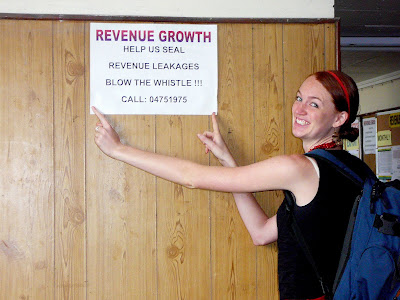
Absurdly dorky picture of me with Revenue Growth sign. Negative five points for posting a geeky photo of myself on a blog; plus two points for finding any photo whatsoever that illustrates revenue growth.

The stark visual image of the opening IMF mission meeting turns out to be quite deceptive. Despite the observable differences, the Government of Liberia and the IMF have a great deal in common, and an exceedingly positive and collaborative relationship. Much like the IMF, the senior leadership of the Government of Liberia is dominated by economic technocrats with years of prior work experience at the World Bank and international institutions. Not only does the President actually welcome the IMF's advice and scrutiny, but there also exists a great deal of synergy between the IMF's philosophies of economic reform and macroeconomic stability and the policies of the Liberian Government.

Moreover, the IMF team that works on Liberia -- including in particular the resident representative of the IMF who is based in Monrovia -- is constructive, dedicated, collaborative, helpful, and involved. Even the much maligned conditionality that the IMF imposes has been largely productive in Liberia. The policy benchmarks tied to the IMF's "Staff Monitored Program" carry with them very weighty carrots and sticks (particularly eligibility for multilateral debt relief), and thus are among the highest priorities of the government. The result is what I call the “‘very urgent’ breakthrough:” the ability of a specific deadline to rise above the mountainous stack of "very urgent" memos and directives -- a stack so monstrous that even the most committed and competent staff cannot attend to all of the demands -- and command the attention of senior management, all the way up to the President.

During my time in Monrovia, I was struck by the impression that everyone was on the same team, the IMF and Government alike, all working towards the same goals. And yet had the IMF and Liberian Government actually been on the same team, it is simply inconceivable that the coach would have distributed the team's talent, remuneration and assets as it stands now. Virtually every single member of the IMF team held a doctoral degree; on the Government side, just one person in the entire ministry (Minister Sayeh) held a doctoral degree. The disparity in pay scale was equally as stark, with the senior Liberian civil servants in our Ministry having undertaken enormous pay cuts. The IMF offices in Monrovia stand in complete contrast to our Finance Ministry building. With its high speed internet access, pristine office, supportive administrative staff, and functioning copier machines, the IMF operated like a well greased machine, whereas we at the Finance Ministry squeaked by on a shoe string. Getting things done was infinitely easier in the IMF setup, and seeking their assistance was sometimes the only way to get things done. For instance, our malfunctioning copy machine proved a very large glitch the night before an important two-day budget cycle workshop that we had planned for weeks. To print copies of the presentations for the donors and government officials attending the workshop, we had to outsource our copying to the IMF office -- which, for a staff less than 10% of our Ministry's staff, had a very advanced (and functioning!) copy machine.

Beyond the obvious equity considerations, the very effectiveness of the IMF is called into question by this distribution of resources. Unlike many donors that operate their own programs independently and could arguably make a case for their employment of the best talent, the IMF in Liberia does not actually do anything per se. (At this point under the SMP, the IMF is not even providing funding.) Their primary purpose is to advise, monitor, and evaluate. Thus while their mission ostensibly is to ensure that Liberia's macroeconomic policy is sound and that public financial management is strengthened, it is the Liberian government that will actually do this, not the IMF. The IMF, for its part, observes the Government's efforts, double checks every number, re-crosses every t and re-dots every i, and gives Liberia performance marks in the equivalent of a report card. To be sure, in countries with weak political commitment or bad policies, the pressure of the IMF breathing down the necks of finance ministries may avert the worst policy decisions and motivate reform. Yet in a country such as Liberia -- where the Government is wholeheartedly committed to the reforms but where weak internal capacity limits the speed and quality of progress --- what is needed is not someone to check their work, but someone to do the work!

Short of revamping the infrastructure of international financial institutions, a low hanging fruit that the IMF should consider is salary compensation for senior civil servants in developing countries. Relying on the good will and civic mindedness of grossly underpaid civil servants is simply not sustainable. If the IMF and its donor siblings are serious about their lofty goals of promoting macroeconomic stability and economic growth, they need to adequately support the only team that can pull off a home run: the governments they work with. Otherwise, even an all star IMF team may just as well sit on the bench.

Tuesday, July 31, 2007

Liberia's Budget Battles: A National Soap Opera

When I arrived in Monrovia, I was informed by Minister Sayeh that the scope of my internship would include a focus on Liberia’s budget. A draft of the national budget had been submitted by the President to the Legislature less than two weeks before I landed in Monrovia. I was just in time, the Minister explained, to work from the end of the Ministry of Finance until it was passed. Stacked against the other issues I had been tasked to work on --- investment policy, debt relief, fiscal policy – the budget seemed, well, a bit dull.

What I did not realize then was that the Minister had just given me a front row seat to the summer’s most explosive drama. In fact, the high profile budget saga that unfolded over the next two months had more sensational plot turns, surprise twists, and preposterous characters than in an entire season of the soap opera “Days of Our Lives.” (Even in its most ridiculous heyday, when Marlena was possessed and Stefano died and came back to life, again.)

My initial read of the draft budget didn’t give even the slightest hint of the ensuing controversy. In fact, during my first tasks of writing talking points for the Cabinet and press releases for the newspapers, I could find nothing but good news to tell. Thanks to robust revenue growth, the draft budget represented a 40% larger pie than the previous year. It was hard to argue with the sectors that stood to benefit from this growth: compared to the previous year, education was to get an additional 44%, health an extra 28%, and public works (and in particular roads!) a needed 59% boost. Civil servants and retirees were designated lucky winners, with well deserved salary increases bound for grossly underpaid government employees. The pot of funds for community development in Liberia’s far flung villages would grow a bit fuller. And more money would be spent on job creation to make a dent into the country’s 85% unemployment rate. Clearly I didn’t need to be a spin doctor to tease out good PR for this budget. Liberia may not have a lot of zeros in its $180 million draft budget, but there is no question that it was aligning all of its pennies with the most important priorities.


Before I could kick up my heels and celebrate, however, the proverbial shit hit the fan. And who was doing the tossing? The Auditor General: the new bully in town, who catapulted overnight from total obscurity to (in)famous national figure. Who is the Auditor General, you might ask? Functionally, the Auditor General is an independent auditor appointed by the President to oversee post-audits of government spending. Reporting directly to the Legislature, the office of the Auditor General is designed broadly to strengthen public financial management and accountability. Normally this role is quiet, behind the scenes, and technical in nature. Normally, of course, but not in this instance. Personally, the Auditor General in Liberia is a relatively young and inexperienced Liberian named John Morlu who returned from many years in the United States to assume his new post. Mr. Morlu’s most distinguishable physical characteristic -- his short stature -- may not have merited psychological analysis, were it not for his decision to wear chunky platform shoes.

Despite his legal mandate to conduct post-audits of spending (translation: after the budget is implemented), Mr. Morlu quickly proved himself trigger happy. After only two months in the country and without ever consulting the Bureau of the Budget or the Finance Ministry, Mr. Morlu authored a dramatic 96 page treatise about the draft budget submitted by the Executive. Translation: a pre-audit. His complaints lodged against the draft budget ranged from the nit picky, such as a lack of page numbers, ironically written in his own page number-less report. To the misguided: criticisms based on misunderstandings that could have easily been cleared up had he simply consulted the government. And finally, to the sensational: allegations of an egregious lack of transparency, disclosure and accountability, and a bold statement that the Legislature’s passage of the budget would constitute a failure of their duty to the Liberian people.

Mr. Morlu unleashed a media frenzy when, without any warning, he brazenly fired off his 96 page treatise along with a confrontational cover letter to the President, the Legislature’s leadership, and the media, all at the same time. Suddenly the rosy front page headlines I had helped craft about the budget were replaced with the damning allegations of the Auditor General. Our team went into rapid response mode. We toiled on the ninth floor of the Finance Ministry until far past my bedtime and drafted the official response for the newspapers and media. The Minsitry chose to toe a sober, fact-based line and clarify the many incorrect accusations put forth by the Auditor General. In the meantime, the President sent a three page letter to the Auditor General that packed a lot more punch and put Mr. Morlu squarely in his place. And left me cheering over the tenacity of the “Iron Lady.” The letter was subsequently leaked to the press and soon became more ammunition in what was rapidly becoming a sensationalized battle, played out on airwaves and newspapers across Liberia.

The real firestorm was still yet to come. In an interview with Voice of America just a few days later, Mr. Morlu declared to the world that the current government was “three times more corrupt than the former interim transitional government of Charles Gyude Bryant that it replaced.” Morlu contended that he had proof based on a “risk analysis of government performance.” Yet this claim is as outrageous as his allegation of corruption: after just eight weeks on the job, the Auditor General had yet to conduct a single audit of either the interim government or the current government, and could not possibly have had valid data to defend such a sweeping assessment.

Mr. Morlu’s statement proved to be the figurative shot heard round the world, or at least around Liberia’s corner of West Africa. Over the next few weeks, the radio and newspapers talked of little else. “Three times more corrupt” was discussed all over Monrovia and everyone seemed to have a view: senators, government officials, men on the street. In the midst of this highly charged controversy, the Legislature announced a public hearing to debate the Auditor General’s concerns with the draft budget and called upon Mr. Morlu, the Budget Director, and (Finance) Minister Sayeh to testify. Another late night was pulled to help the Minister prepare her testimony, including her opening remarks and the responses to questions about the budget and revenue projections.

The atmosphere at the hearings was nothing short of a circus. The stage was actually set more for a circus than a government hearing: two floors of stadium-style seating overlooked the ground floor of the immense conference center, where the Legislature’s leadership and the key speakers sat. Filling one half of the seating on the ground floor were the members of the Legislature. On the other side and above sat the public: a rowdy group of some 200 men whose selective cheering revealed their overwhelming support for the Auditor General. (Or, perhaps, simply an opposition to the Executive). Filling the rest of the space were scores of journalists and armed UN security.

The hearings, dubbed by one newspaper as the “most anticipated” event of the year, commenced with opening remarks by the leadership of the Legislature, followed by statements made by legislators from their peanut gallery. The pomp and circumstance of these statements was striking. 20 journalists with microphones would swarm around a bellowing legislator as he stood shaking his fists, and would then sprint to the next ranting legislator and thrust their microphones in his face. The speeches were rewarded with loud cheers from the crowd, forcing the Speaker to repeatedly pound his gavel to maintain order.

The Auditor General was the first to be called to speak, and speak he did. For over an hour. Two weeks of national controversy served only to egg on Mr. Morlu, and his testimony was even more sensational than his earlier treatise. Minister Sayeh spoke next, and delivered her concise but extremely pointed opening remarks. The highlight: her line, “If the Auditor General needed to be educated about the budget process and public finances in Liberia, all he needed to do was ask.” Boo-ya. The Budget Director picked up where Minister Sayeh left off, delivering such an impassioned and hard-hitting oration that the crowd went wild. Unruly spectators from the stands spilled onto the main floor, angry legislators jumped to their feet yelling, and the futile gavel pounding of the Speaker did nothing to quell the chaos. In a matter of a few frenetic minutes, the hearing was cancelled, Minister Sayeh and other senior officials were evacuated by UN armed guards, and – at the height of absurdity – one of the most senior Cabinet members was accused of threatening a journalist. Which was later twisted to even more far fetched accusations of his threatening the Auditor General himself. The front page of all of the newspapers the next day showed a dejected journalist laying on the ground, a photo of the accused minister looking as if in a mug shot, and highly dramatized accusations that, in the US, would have led to lawsuits.

In the end, the Legislature did pass the budget last week. After two months of debate, one of the only changes that the Legislature prioritized was a very large increase in their own pot of money and personal benefits: far less attention was paid to addressing the concerns raised by the Auditor General, several of which were valid. Lost in the fist fighting was the actual substance behind the controversy: the budget. What the media, the public, and the legislators seemed to focus on were the sparks flying and not the source of the fire, and in the end very little was gained. The opportunity to constructively engage the public and the government on important issues of public financial management and the budget process, and ultimately raise the standards of the budget, was lost entirely. The budget that ultimately passed was not only no better than the draft critiqued by the Auditor General, in my opinion it was worse, with a disproportionately large budget for the Legislature that rivaled the entire education budget and dwarfed the spending in far more crucial sectors.

Liberia’s budget saga raised several lessons. The first is the challenge of effectively communicating facts and engaging the public on policy matters in the Liberian context -- one characterized by widespread illiteracy and very low levels of education. In such an environment, nuance and factual details are too easily trumped by a simple, powerful message like "three times more corrupt" that can easily be communicated, irregardless of its analytical merit. Magnifying this challenge is the weakness of Liberia's media. Far from playing a critical arbitrar in the sensationalized debate, helping readers sift through the hyped accusations, Liberia's newspapers simply played agitator.

A second lesson is the fragility of the reform process. Liberia's government is deeply committed to reforming its governance architecture, and has set off on an ambitious set of simultaneous reform: public financial management, legal and judicial reforms, and more. Troubling is the reality that an imperfect reform in one area can severely impair progress in another, derailing even the best of efforts. For instance, hiring an Auditor General should strengthen accountability and governance. Yet in this case, hiring the wrong Auditor General led to a mammoth distraction from the Government's earnest efforts to tackle corruption, and has resulted in the country losing some of the ground it worked so hard to gain. Likewise, a poorly functioning media can, counterintuitively, hinder efforts to inform the public and communicate facts over hype. And when self-serving Legislators are elected to serve the country, "good" democracy can be antithetical to good governance.

Far from being dull Liberia's budget process was, as it turns out, unforgettable.