Wednesday, May 14, 2008

Full Circle: A Long Road to Microfinance in Liberia


"Mol, why is there no micro lending agency in Liberia?"

The question was planted by my father in my e-mail inbox last summer when I was in Liberia. At that point, my dad -- Drew Kinder -- was already a budding microfinance enthusiast. This interest had started a few months earlier when he stumbled upon a Nicholas Kristof op-ed in the NY Times about kiva.org: an innovative website that links ordinary citizens (like my dad) directly with profiles of prospective borrowers in impoverished countries. As a successful entrepreneur himself, my dad instantly connected with the innovative nature of the start-up site and its core message of empowerment through entrepreneurship. Quickly hooked on kiva, my dad started a new weekly ritual. Every Sunday, he would browse the kiva website from his leather chair in suburban Buffalo, find a deserving entrepreneur in a far-off place like Tajikistan or Tanzania, and make a $25 loan.

My dad was not alone in his ritual. One Sunday morning late last summer, my dad went to the Kiva website to make his weekly loan and discovered that the site was empty. Kiva had received so much publicity from the likes of Oprah and Bill Clinton that they were flat out of borrowers. Yet this dearth of borrowers belied what my dad saw as a huge need in places like Liberia. All throughout the summer, my dad had followed closely the experiences of Team Liberia through our blogs. It dawned on him that he never once came across a Liberian entrepreneur on kiva's website, which puzzled him. Are there not Liberian entrepreneurs who could use the sort of loans my dad gave every week? And if so, where are the MFIs that would serve them? Thus my dad's email to me in Liberia, in which he wrote:

"This raises the question of why there is no micro lending agency in Liberia. Would it not be possible to kick start a micro-loan effort there? Kiva is actively looking for borrowers. This seems like low hanging fruit compared to all the intractable problems you uncovered over there. Just a thought. Perhaps you could discuss it with the team. If necessary, I would go there this winter to help get something started." --Dad--

When I raised this question with Team Liberia, we were stumped. With all of the global attention to microfinance as a tool for reducing poverty, particularly among poor women, Liberia seemed ripe for such an intervention. Everywhere you turn in Monrovia, you are certain to be greeted by one ubiquitous sight: women of all ages selling vegetables and other goods on street corners. In fact, in Monrovia a striking 40 percent of working women are employed as street vendors or petty trades, and another 29 percent are engaged as "market women." In total, a whopping 174,000 women work as "market women" across Liberia, and an even greater number eke out meager livings as petty traders. Many of these women are the primary bread winners of families averaging seven members. Yet less than 6,000 women in the entire country have any access to formal credit and the sort of small loans that my dad makes every week from his leather chair in Buffalo.
Petty trader selling vegetables on a side street in Monrovia

My dad was clearly unsatisfied with our feeble response to his question. So he decided to take action. One day when browsing the kiva website, he came across a notice for a program called "kiva fellows." Kiva fellows volunteer to move to a developing country for several months, on their own dime, to support one of kiva's partner microfinance institutions. Unbeknown to the rest of us, my dad submitted an application, explaining that his motivation was to learn from the ground level how microfinance works so that he can ultimately help bring microfinance services to Liberia. By November, my dad was boarding a plane headed for Kampala, tasked to support a small MFI called "Share an Opportunity."

Kampala is a very, very long way from my dad's comfortable leather chair in suburban Buffalo. And it was with no small sense of pride that I heartily applauded my dad's courageous sojourn halfway across the globe, and his transformation from quite literally an armchair microfinance enthusiast to a full fledged practitioner. In fact, so proud of my dad was I that I simply could not resist joining him, albeit briefly, in Kampala. After relishing my dad's experiences from afar through his beautifully written blog, I flew to Kampala in January, en route to Liberia to work for several week for the Ministry of Finance during my winter break.


My visit with my dad in Kampala was among the most meaningful times I have ever shared with him. Our evenings were spent catching up on his porch over cold Ugandan beer and languishing over long dinners with his motley crew of new friends (including priests, nuns, young USAID staff, and Bangladeshi development workers). My dad's practical eye as a business man combined with his compassion and incisive insights kept me riveted and asking questions for hours. During the days, I enjoyed a crash course of sorts in microfinance. We visited with the staff at the headquarters of Share an Opportunity and the esteemed Bangladesh-based BRAC. To get a closer look at the operations of the MFIs, we spent a day observing the group meetings of female entrepreneurs in the slums of Kampala and also visited a rural development and savings scheme outside of Kampala. In between these adventures, I zipped around town after my dad in local matatus (i.e. 12 person vehicles) and "boda-bodas" (motorcycles), marveling at my father's fearlessness and ease in Kampala's unruly traffic.


My dad with members of one of BRAC Uganda's microcredit groups in the Kalerwe branch

My dad handing out his famous "Your future is bright!" pens

More than anything else I witnessed during my microfinance crash course, BRAC Uganda stood out as a star. I was extremely impressed with the organizational effectiveness, vision and reach of their operations. BRAC's model entails lending to groups of 20-30 women in some of Uganda's most impoverished pockets. The woman meet regularly and make small, fixed payments to pay off their small loans. BRAC long ago perfected its group lending model in Bangladesh, where the organization began several decades ago and now provides credit to more than six million Bangladeshis. Only last year did BRAC arrive in Uganda -- heeding President Clinton's call at his annual summit for the organization to expand its operations to Africa -- and already BRAC Uganda is serving more poor clients than any other MFI in Uganda. My dad worked closely with BRAC during his stint as a kiva fellow, and shares my enthusiasm and respect for the organization.


The impact of BRAC Uganda's work came alive to me during one of the more touching moments of my visit. My dad and I had just spent the afternoon observing groups of women in their weekly meetings. After the meeting, we went to the home of one of the women to learn more about how she has put her small loan to use. It was this moment, as I observed my dad sitting in the home of a brave grandmother named Regina, in the midst of a Kampala slum, that microfinance became real to me. As my dad sat with Regina in her tiny, dark, makeshift home, he gradually drew out her story. Regina was the primary care giver of a brood of eleven grandchildren, all of whom had been orphaned by AIDS. Regina's story, captured beautifully by my dad in his blog entry, is among the most powerful anecdotes I have encountered about the potential of microfinance to change lives in small but meaningful ways. By taking out small loans through a BRAC group, Regina has been able to expand her business of selling roast chickens, and to use the proceeds to start a new business of selling fresh water. The result? Paying her orphaned grandchildren's school fees, paving the way for a brighter future out from circumstances that might seem anything but bright.

My dad with Regina
In my response to my dad's moving blog post about Regina, I reflected: "Were I to read this anecdote on an MFI's website, I might discount this as an outlier; an exceptional, token experience. Yet having met Regina myself last week, I am more convinced than ever of the potential of microcredit and organizations like BRAC to make a real and measurable impact on the lives of women like Regina -- women whose experiences of hardship, sacrifice, and struggles are frighteningly common in many corners of the world.

Microcredit and group lending are certainly not a panacea, nor a magic anecdote for poverty. But experiences like Regina remind me that microcredit does indeed perform small miracles, by harnessing the energy, passion, entrepreneurship and tirelessness of care takers like Regina. Helping them overcome some of the daunting obstacles they face in providing for their families: putting more bread on the table today. And, through their greater success in eking out a better living from the meager circumstances they have inherited, giving renewed hope to another generation: in Regina's case, a son with a law degree from Uganda's most prestigious university and education for eleven orphaned grandchildren."

As I flew to Monrovia from Kampala a few days later, I thought about just how many Reginas there are in Liberia. And yet how few BRACs are operating in Liberia to address the unmet credit needs of Liberia's Reginas. In fact, there are just two small MFIs serving all of Liberia, with a tiny client base. This deficit is even more striking given the context: a very poor country led by a president with an explicit political mandate to support her country's market women, deemed her "greatest constituency." (President Sirleaf's own grandmother was a market woman). What would it take, I thought, to replicate what I had seen in Kampala's Kalerwe slums to women across Liberia?

When I arrived in Monrovia, I was immediately catapulted from the grassroots perspective I had enjoyed in my microcredit crash course to a birds-eye, macro view of national policy. My job was to work on Liberia's national Poverty Reduction Strategy: Liberia's big picture policy objectives and strategies for the next three years, such as building roads and infrastructure, and creating an enabling environment for private sector development. At first blush, this sort of central planning seemed at once at odds with the grassroots perspective I had relished in Uganda, and also straight out of the Jeff Sachs corner of the over hyped Sachs-Easterly standoff. (An observation made only the more surreal by my chance run-in with Jeff Sachs himself at the breakfast buffet at the Mambo Point hotel in Monrovia). Seeing the immediate and measurable effect of microcredit loans on Ugandan women illustrated to me the imperative of hasty action: Liberians clearly can't simply wait for the government to change their lives. And yet, on the other hand, without improvements in the broader environment -- without the construction of roads to allow traders to access markets, for instance -- simply providing microfinance will only provide small improvements at the margin, without fundamentally changing economic opportunities. Liberia in a sense defied the polarized debate. The needs are so great, a little of everything is urgently needed: searching, planning, and most definitely microfinance.

(Side note: my classmate Emily Stanger and I explored this question further in our graduate thesis:"Fulfilling President Sirleaf's Mandate: Ensuring Women Their 'Proper Place' in Liberia's Development." We analyze the great need in Liberia for expanded access to financial services for small-scale women entrepreneurs, and provide recommendations for a better regulatory environment for microfinance and the provision of parallel business and skills training for women borrowers. Emily and I were invited to present these findings to President Sirleaf just before she delivered the commencement address at the Kennedy School.)

Emily and I presenting our graduate thesis to President Sirleaf

In March, my dad returned to Buffalo. Heralding his three month kiva fellowship as one of the most meaningful and enriching experiences of his entire life, my dad assumed his well deserved seat back in his leather arm chair. Part of his mission had been accomplished: he had indeed learned a great deal about how microfinance works, and had enlightened me in the process.

Just a month later, the second half of my dad's mission was completed. Mr. Ariful Islam, the dynamo country program coordinator of BRAC Uganda with whom my father had worked closely, wrote that BRAC had registered in Liberia. BRAC's team in Liberia was barreling forward to commencing operations in at least ten branches in Monrovia by the summer time. Something tells me that my dad I have another adventure in store...

In just two weeks, President Sirleaf will be the keynote speaker at my graduation from the Kennedy School. In the audience, sitting alongside me, will be my dad and my family. As President Sirleaf speaks, my Kennedy School experience -- and the overseas odysseys of my family -- will come full circle. Addressing the school in September of 2006 at the very start of my two year program, President Sirleaf invited my classmates and me to "come to Liberia." In so doing, she planted a seed that would ultimately change the lives of three members of the Kinder family. Her call was heeded not only by me, twice, but also by my sister Colleen (and writer extraordinaire who spent 3 weeks with me in Liberia and whose timeless essay on Liberia will soon be published), and ultimately my father, who felt so moved he literally moved. Halfway across the world. And touched many lives in the process, including my own. And, if BRAC works its magic in Liberia as I believe it will, perhaps several more Reginas.

The Kinder family at President Sirleaf's Kennedy School commencement address

****************
****************
***UPDATE: BRAC Liberia is now up and running. According to a March 2009 BRAC blog post, the Liberia office now has a team that will lead programming in three areas:
  • an agricultural program that will help rural farmers grow better crops to feed their families and sustain their livelihoods;

  • a microfinance program; and

  • a health program that will train BRAC community health promoters, women who go door-to-door to visit 150 homes in their communities, providing life-saving health information, basic health services and access to a variety of health products.

Saturday, September 1, 2007

The IMF & the Ministry of Females

"Again???!!" The copier was out of paper. Again. And the second copier was out of ink. And paper. Again. By the time I finally unearthed a functioning copier, printed my document, and raced up the stairs to the 10th floor conference room --the elevator had been out of order for two weeks already -- the opening meeting of the visiting IMF mission was already underway.

My tardiness meant that everyone was already seated around the conference room table when I arrived. The scene in front of me was almost too striking to be true. With their backs to me sat a row of seven Caucasian men in stereotypical dark suits and smart eyeglasses. Across from the suited men, and with the windows and the clamorous noise from Broad Street behind them, sat six African women. Several of these women were wearing brightly colored African suits, and all of them wore smart eyeglasses. So extreme were the contrasts between the two sides of the table -- in terms of gender, race, geographic representation, fashion -- that the only visible similarity was the preponderance of eye glasses.

While it may not be surprising that the suited men represented the IMF -- although I was assured later by the visiting IMF team that the teams are normally more diverse -- the fact that the senior Ministry of Finance team is overwhelmingly female has turned many heads. Not only is the Minister herself female, but seven of the top ten deputy and assistant minister positions are held by women. In my opinion, it is no coincidence that this female leadership has coincided with a reputation for effectiveness and some of the biggest successes of the Sirleaf administration, including a doubling of revenues.


The women of the Ministry of Finance: me, Dabah Varpilah, Minister Antoinette Sayeh, Elfreda Tamba, Aletha Brown, and Angelique Weeks
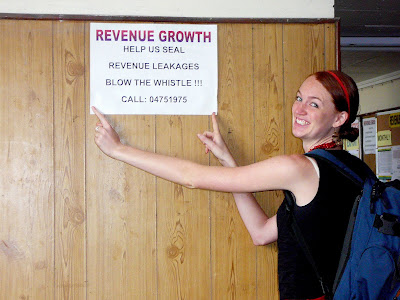
Absurdly dorky picture of me with Revenue Growth sign. Negative five points for posting a geeky photo of myself on a blog; plus two points for finding any photo whatsoever that illustrates revenue growth.

The stark visual image of the opening IMF mission meeting turns out to be quite deceptive. Despite the observable differences, the Government of Liberia and the IMF have a great deal in common, and an exceedingly positive and collaborative relationship. Much like the IMF, the senior leadership of the Government of Liberia is dominated by economic technocrats with years of prior work experience at the World Bank and international institutions. Not only does the President actually welcome the IMF's advice and scrutiny, but there also exists a great deal of synergy between the IMF's philosophies of economic reform and macroeconomic stability and the policies of the Liberian Government.

Moreover, the IMF team that works on Liberia -- including in particular the resident representative of the IMF who is based in Monrovia -- is constructive, dedicated, collaborative, helpful, and involved. Even the much maligned conditionality that the IMF imposes has been largely productive in Liberia. The policy benchmarks tied to the IMF's "Staff Monitored Program" carry with them very weighty carrots and sticks (particularly eligibility for multilateral debt relief), and thus are among the highest priorities of the government. The result is what I call the “‘very urgent’ breakthrough:” the ability of a specific deadline to rise above the mountainous stack of "very urgent" memos and directives -- a stack so monstrous that even the most committed and competent staff cannot attend to all of the demands -- and command the attention of senior management, all the way up to the President.

During my time in Monrovia, I was struck by the impression that everyone was on the same team, the IMF and Government alike, all working towards the same goals. And yet had the IMF and Liberian Government actually been on the same team, it is simply inconceivable that the coach would have distributed the team's talent, remuneration and assets as it stands now. Virtually every single member of the IMF team held a doctoral degree; on the Government side, just one person in the entire ministry (Minister Sayeh) held a doctoral degree. The disparity in pay scale was equally as stark, with the senior Liberian civil servants in our Ministry having undertaken enormous pay cuts. The IMF offices in Monrovia stand in complete contrast to our Finance Ministry building. With its high speed internet access, pristine office, supportive administrative staff, and functioning copier machines, the IMF operated like a well greased machine, whereas we at the Finance Ministry squeaked by on a shoe string. Getting things done was infinitely easier in the IMF setup, and seeking their assistance was sometimes the only way to get things done. For instance, our malfunctioning copy machine proved a very large glitch the night before an important two-day budget cycle workshop that we had planned for weeks. To print copies of the presentations for the donors and government officials attending the workshop, we had to outsource our copying to the IMF office -- which, for a staff less than 10% of our Ministry's staff, had a very advanced (and functioning!) copy machine.

Beyond the obvious equity considerations, the very effectiveness of the IMF is called into question by this distribution of resources. Unlike many donors that operate their own programs independently and could arguably make a case for their employment of the best talent, the IMF in Liberia does not actually do anything per se. (At this point under the SMP, the IMF is not even providing funding.) Their primary purpose is to advise, monitor, and evaluate. Thus while their mission ostensibly is to ensure that Liberia's macroeconomic policy is sound and that public financial management is strengthened, it is the Liberian government that will actually do this, not the IMF. The IMF, for its part, observes the Government's efforts, double checks every number, re-crosses every t and re-dots every i, and gives Liberia performance marks in the equivalent of a report card. To be sure, in countries with weak political commitment or bad policies, the pressure of the IMF breathing down the necks of finance ministries may avert the worst policy decisions and motivate reform. Yet in a country such as Liberia -- where the Government is wholeheartedly committed to the reforms but where weak internal capacity limits the speed and quality of progress --- what is needed is not someone to check their work, but someone to do the work!

Short of revamping the infrastructure of international financial institutions, a low hanging fruit that the IMF should consider is salary compensation for senior civil servants in developing countries. Relying on the good will and civic mindedness of grossly underpaid civil servants is simply not sustainable. If the IMF and its donor siblings are serious about their lofty goals of promoting macroeconomic stability and economic growth, they need to adequately support the only team that can pull off a home run: the governments they work with. Otherwise, even an all star IMF team may just as well sit on the bench.

Tuesday, July 31, 2007

Liberia's Budget Battles: A National Soap Opera

When I arrived in Monrovia, I was informed by Minister Sayeh that the scope of my internship would include a focus on Liberia’s budget. A draft of the national budget had been submitted by the President to the Legislature less than two weeks before I landed in Monrovia. I was just in time, the Minister explained, to work from the end of the Ministry of Finance until it was passed. Stacked against the other issues I had been tasked to work on --- investment policy, debt relief, fiscal policy – the budget seemed, well, a bit dull.

What I did not realize then was that the Minister had just given me a front row seat to the summer’s most explosive drama. In fact, the high profile budget saga that unfolded over the next two months had more sensational plot turns, surprise twists, and preposterous characters than in an entire season of the soap opera “Days of Our Lives.” (Even in its most ridiculous heyday, when Marlena was possessed and Stefano died and came back to life, again.)

My initial read of the draft budget didn’t give even the slightest hint of the ensuing controversy. In fact, during my first tasks of writing talking points for the Cabinet and press releases for the newspapers, I could find nothing but good news to tell. Thanks to robust revenue growth, the draft budget represented a 40% larger pie than the previous year. It was hard to argue with the sectors that stood to benefit from this growth: compared to the previous year, education was to get an additional 44%, health an extra 28%, and public works (and in particular roads!) a needed 59% boost. Civil servants and retirees were designated lucky winners, with well deserved salary increases bound for grossly underpaid government employees. The pot of funds for community development in Liberia’s far flung villages would grow a bit fuller. And more money would be spent on job creation to make a dent into the country’s 85% unemployment rate. Clearly I didn’t need to be a spin doctor to tease out good PR for this budget. Liberia may not have a lot of zeros in its $180 million draft budget, but there is no question that it was aligning all of its pennies with the most important priorities.


Before I could kick up my heels and celebrate, however, the proverbial shit hit the fan. And who was doing the tossing? The Auditor General: the new bully in town, who catapulted overnight from total obscurity to (in)famous national figure. Who is the Auditor General, you might ask? Functionally, the Auditor General is an independent auditor appointed by the President to oversee post-audits of government spending. Reporting directly to the Legislature, the office of the Auditor General is designed broadly to strengthen public financial management and accountability. Normally this role is quiet, behind the scenes, and technical in nature. Normally, of course, but not in this instance. Personally, the Auditor General in Liberia is a relatively young and inexperienced Liberian named John Morlu who returned from many years in the United States to assume his new post. Mr. Morlu’s most distinguishable physical characteristic -- his short stature -- may not have merited psychological analysis, were it not for his decision to wear chunky platform shoes.

Despite his legal mandate to conduct post-audits of spending (translation: after the budget is implemented), Mr. Morlu quickly proved himself trigger happy. After only two months in the country and without ever consulting the Bureau of the Budget or the Finance Ministry, Mr. Morlu authored a dramatic 96 page treatise about the draft budget submitted by the Executive. Translation: a pre-audit. His complaints lodged against the draft budget ranged from the nit picky, such as a lack of page numbers, ironically written in his own page number-less report. To the misguided: criticisms based on misunderstandings that could have easily been cleared up had he simply consulted the government. And finally, to the sensational: allegations of an egregious lack of transparency, disclosure and accountability, and a bold statement that the Legislature’s passage of the budget would constitute a failure of their duty to the Liberian people.

Mr. Morlu unleashed a media frenzy when, without any warning, he brazenly fired off his 96 page treatise along with a confrontational cover letter to the President, the Legislature’s leadership, and the media, all at the same time. Suddenly the rosy front page headlines I had helped craft about the budget were replaced with the damning allegations of the Auditor General. Our team went into rapid response mode. We toiled on the ninth floor of the Finance Ministry until far past my bedtime and drafted the official response for the newspapers and media. The Minsitry chose to toe a sober, fact-based line and clarify the many incorrect accusations put forth by the Auditor General. In the meantime, the President sent a three page letter to the Auditor General that packed a lot more punch and put Mr. Morlu squarely in his place. And left me cheering over the tenacity of the “Iron Lady.” The letter was subsequently leaked to the press and soon became more ammunition in what was rapidly becoming a sensationalized battle, played out on airwaves and newspapers across Liberia.

The real firestorm was still yet to come. In an interview with Voice of America just a few days later, Mr. Morlu declared to the world that the current government was “three times more corrupt than the former interim transitional government of Charles Gyude Bryant that it replaced.” Morlu contended that he had proof based on a “risk analysis of government performance.” Yet this claim is as outrageous as his allegation of corruption: after just eight weeks on the job, the Auditor General had yet to conduct a single audit of either the interim government or the current government, and could not possibly have had valid data to defend such a sweeping assessment.

Mr. Morlu’s statement proved to be the figurative shot heard round the world, or at least around Liberia’s corner of West Africa. Over the next few weeks, the radio and newspapers talked of little else. “Three times more corrupt” was discussed all over Monrovia and everyone seemed to have a view: senators, government officials, men on the street. In the midst of this highly charged controversy, the Legislature announced a public hearing to debate the Auditor General’s concerns with the draft budget and called upon Mr. Morlu, the Budget Director, and (Finance) Minister Sayeh to testify. Another late night was pulled to help the Minister prepare her testimony, including her opening remarks and the responses to questions about the budget and revenue projections.

The atmosphere at the hearings was nothing short of a circus. The stage was actually set more for a circus than a government hearing: two floors of stadium-style seating overlooked the ground floor of the immense conference center, where the Legislature’s leadership and the key speakers sat. Filling one half of the seating on the ground floor were the members of the Legislature. On the other side and above sat the public: a rowdy group of some 200 men whose selective cheering revealed their overwhelming support for the Auditor General. (Or, perhaps, simply an opposition to the Executive). Filling the rest of the space were scores of journalists and armed UN security.

The hearings, dubbed by one newspaper as the “most anticipated” event of the year, commenced with opening remarks by the leadership of the Legislature, followed by statements made by legislators from their peanut gallery. The pomp and circumstance of these statements was striking. 20 journalists with microphones would swarm around a bellowing legislator as he stood shaking his fists, and would then sprint to the next ranting legislator and thrust their microphones in his face. The speeches were rewarded with loud cheers from the crowd, forcing the Speaker to repeatedly pound his gavel to maintain order.

The Auditor General was the first to be called to speak, and speak he did. For over an hour. Two weeks of national controversy served only to egg on Mr. Morlu, and his testimony was even more sensational than his earlier treatise. Minister Sayeh spoke next, and delivered her concise but extremely pointed opening remarks. The highlight: her line, “If the Auditor General needed to be educated about the budget process and public finances in Liberia, all he needed to do was ask.” Boo-ya. The Budget Director picked up where Minister Sayeh left off, delivering such an impassioned and hard-hitting oration that the crowd went wild. Unruly spectators from the stands spilled onto the main floor, angry legislators jumped to their feet yelling, and the futile gavel pounding of the Speaker did nothing to quell the chaos. In a matter of a few frenetic minutes, the hearing was cancelled, Minister Sayeh and other senior officials were evacuated by UN armed guards, and – at the height of absurdity – one of the most senior Cabinet members was accused of threatening a journalist. Which was later twisted to even more far fetched accusations of his threatening the Auditor General himself. The front page of all of the newspapers the next day showed a dejected journalist laying on the ground, a photo of the accused minister looking as if in a mug shot, and highly dramatized accusations that, in the US, would have led to lawsuits.

In the end, the Legislature did pass the budget last week. After two months of debate, one of the only changes that the Legislature prioritized was a very large increase in their own pot of money and personal benefits: far less attention was paid to addressing the concerns raised by the Auditor General, several of which were valid. Lost in the fist fighting was the actual substance behind the controversy: the budget. What the media, the public, and the legislators seemed to focus on were the sparks flying and not the source of the fire, and in the end very little was gained. The opportunity to constructively engage the public and the government on important issues of public financial management and the budget process, and ultimately raise the standards of the budget, was lost entirely. The budget that ultimately passed was not only no better than the draft critiqued by the Auditor General, in my opinion it was worse, with a disproportionately large budget for the Legislature that rivaled the entire education budget and dwarfed the spending in far more crucial sectors.

Liberia’s budget saga raised several lessons. The first is the challenge of effectively communicating facts and engaging the public on policy matters in the Liberian context -- one characterized by widespread illiteracy and very low levels of education. In such an environment, nuance and factual details are too easily trumped by a simple, powerful message like "three times more corrupt" that can easily be communicated, irregardless of its analytical merit. Magnifying this challenge is the weakness of Liberia's media. Far from playing a critical arbitrar in the sensationalized debate, helping readers sift through the hyped accusations, Liberia's newspapers simply played agitator.

A second lesson is the fragility of the reform process. Liberia's government is deeply committed to reforming its governance architecture, and has set off on an ambitious set of simultaneous reform: public financial management, legal and judicial reforms, and more. Troubling is the reality that an imperfect reform in one area can severely impair progress in another, derailing even the best of efforts. For instance, hiring an Auditor General should strengthen accountability and governance. Yet in this case, hiring the wrong Auditor General led to a mammoth distraction from the Government's earnest efforts to tackle corruption, and has resulted in the country losing some of the ground it worked so hard to gain. Likewise, a poorly functioning media can, counterintuitively, hinder efforts to inform the public and communicate facts over hype. And when self-serving Legislators are elected to serve the country, "good" democracy can be antithetical to good governance.

Far from being dull Liberia's budget process was, as it turns out, unforgettable.

Sunday, July 22, 2007

Lots of love for Team Liberia

Family dinner

Celebrating Yue Man's completion of Liberia's application for (many millions of dollars of) funding for a tuberculosis program fom the Global Fund.

Our daily commute (in a 15 passenger van) to work
Two words describe my feelings toward Team Liberia: "the BEST!" [Team Liberia, this refers to "the best" as in the "the BEST best," and not just "the best."] Team Liberia has been the source of endless giggles, hilarity, memorable adventures, and just plain joy. We've morphed into a hybrid of summer camp (with girls vs. boys waterballoon fights), family (eating dinner every night together) and Real World Monrovia (with just a tad less drama). Consumed by intense work schedules and equally intense surroundings, it has been a great relief to have such a fabulous group to come home to every night. Monrovia, surpisingly, has its fair share of nightlife: a handful of outdoor bars with live music, a few favorite spots right in the beach, a hotel restaurant-turned-coffeeshop, and even a fabulous sushi restaurant. These have given us enough enough escapes to keep our spirits and energy up. Most evenings, though, we bond at the Baptist Compound -- feeding our addictions for mindless TV series (the OC and Sex and the City), teasing each other about our eccentric personality traits, and reflecting on our experiences and work. To put it mildly, I adore Team Liberia.

A Diamond is (Not Liberia’s) Forever

Liberia is poor. Its people are poor, its government is poor, the state of the country’s infrastructure is poor. You’d be hard pressed indeed to find a country much poorer than Liberia today.

And yet, paradoxically, Liberia should be filthy rich. From the perspective of its natural resources, Liberia boasts a literal gold mine. Open a map of Liberia, close your eyes and draw an X, and you may very well have located your fortune. Dig below the ground and you’ll find diamonds, iron ore, gold, and other lucrative minerals. Look up and you’ll run straight into one of the gazillions of trees that comprise Liberia’s vast and valuable forest. And, if you’re the kind of pirate who is willing to take a gamble on your treasure, head straight for Liberia’s continental shelf and be first in line to discover possible new reserves of oil and gas.

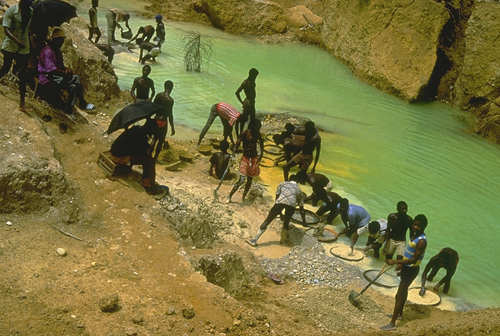
Tragically, Liberians know precious little of the bling bling from these riches, and far too much bang bang. The hefty profits from extractive industries – diamonds, gold, forestry – have for decades been used against Liberia’s people instead of for them. These riches fuelled the prolonged civil conflict, putting hundreds of thousands of guns into the hands of rebel factions and child soldiers. Corrupt business deals and outrageous plundering by (morally repugnant) political leaders from previous governments meant that Liberia saw almost none of the proceeds from the sales of its diamonds and trees.

The solution seems all too obvious and basic. Governments should be the honorable stewards of a country’s resources. Any leader who steals should be locked up. Private (and particularly foreign) companies should not get away with highway robbery: a reasonable share of their profits should be transferred to the country from whose land these companies are getting rich, and used responsibly to fund schools, hospitals, and roads. And the ultimate consumers of these products --- in particular the millions of love-struck American men who purchase the bulk of the world’s diamonds for their future brides --- should take great care to ensure that their insatiable demand for Liberia’s buried treasures results in development, and not destruction.

For their end, the Government of Liberia is now doing its part. Last week the Government launched its participation in the “Extractive Industries Transparency Initiative” in a jubilant ceremony at City Hall, complete with balloons, singing teenagers and the requisite presence of government and donor dignitaries. At the fanfare event, President Sirleaf announced the Government of Liberia’s voluntary pledge to enact a more transparent, accountable and equitable management of its extractive resources. Basically, this will entail publication of all payments made by mining, petroleum and forestry companies to the government, and the reconciliation and external audit of payment and revenue information.

Me, Minister Sayeh, Dan Honig, and Dabah (special assistant) at the EITI launch


A similar program in Nigeria has made progress in ensuring that oil revenues actually end up in the coffers of the national government. Whether or not this money escapes Nigerian’s notorious corruption as it filters to the local level is a separate question, of course. And a skeptical reader may also question the effectiveness of governments in spending this money and at the end of the day, whether it will actually improve the lives of everyday citizens. However limited this progress, though, it does suggest that the marriage of strong political commitment at the top and watchdog programs can help avert the flagrant robbery of the past.

As Liberia now throws open the doors of its mining and forestry operations, the challenge ahead lies in translating this political commitment into urgently needed revenues, employment, and infrastructure. Liberia's development prospects in the next decade will depend heavily on these extractive industries. In the absence of reliable electricity, a trained workforce, and uninterrupted peace and stability, I'm dubious about the prospects for much other private sector activity, like tourism or manufacturing, at least in the short term. Liberia's natural resources are so valuable to the rest of the world that they will attract investment, regardless of the constraints that scare other nervous investors away. The huge Mittal Steel deal and other new concession agreements will soon revive these critical industries and jump start the economy. Perhaps this time around, Liberians will finally get a piece of their treasure.


**To learn more about Liberia's efforts to comply with the Kimberly certification for its diamonds, see Kaysie Brown's recent blog posting


** For anyone in the market for a diamond engagement ring, check out Amnesty International and Global Witness for more information on how to purchase a conflict-free diamond.


** Click here to read the full text of the President's speech.

Tuesday, July 17, 2007

Colleen has arrived!


Colleen has arrived in Monrovia! My little sister (and favorite side kick) Colleen will be spending the next two weeks with me in Liberia, followed by a two week adventure in Senegal and Mali. Colleen -- a third year student in the University of Iowa's nonfiction writing program -- and I made a pact to travel as much as possible together while we're both in graduate school, capitalizing on our overlapping breaks and our mutual wanderlust. Traveling with Colleen is always a joy. Not only do I relish her writer's eye-view of her surroundings (which contrasts nicely with my policy wonky lense), but I also cherish the quality sister bonding time. During her time in Liberia, Colleen will be writing an article for Ms. Magazine about women leaders in Liberia ,and will be retracing and updating some of Graham Greene's novice meanderings from his book "A Journey Without Maps." And of course making me giggle incessantly. Catch us soon in Timbuktu...

**For more on Colleen's writing, see:

Sunday, July 8, 2007

The bold and the beautiful: Liberian lapa


Me, Emily, Matilda, JR and Yue Man shopping for lapa in the Waterside market in Monrovia


It's not exactly a well kept secret that I worship bright colors. Green, yellow and most of all red: the brighter the better. My recent year in India unleashed my inner Crayola crayon box and my wardrobe hasn't turned back since. Liberia, remarkably, has managed to take this up a notch by adding a new twist to my affinity for shockingly bright colors: big, bold, beautiful patterns. Here in Liberia, female fashion is characterized by suits (i.e. matching long skirts and tops) made from "lapa" cotton decorated in daring patterns. Guided by the expert fashion advice of Emily's colleague Matilda, the female contingent of our intern group has become regulars at our tailor's shop, growing more and more adventurous with each of our orders for lapa suits. So far I've shied away from the matching headdress, out of fear of looking like the single most preposterous (and gigantically tall) expat in West Africa. If my Liberian colleagues have their way, though, I may soon be decked out like a full on African princess. Or spotted giraffe. Jury's out.