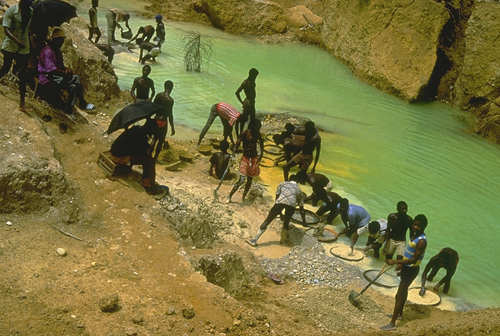
And yet, paradoxically, Liberia should be filthy rich. From the perspective of its natural resources, Liberia boasts a literal gold mine. Open a map of Liberia, close your eyes and draw an X, and you may very well have located your fortune. Dig below the ground and you’ll find diamonds, iron ore, gold, and other lucrative minerals. Look up and you’ll run straight into one of the gazillions of trees that comprise Liberia’s vast and valuable forest. And, if you’re the kind of pirate who is willing to take a gamble on your treasure, head straight for Liberia’s continental shelf and be first in line to discover possible new reserves of oil and gas.
Tragically, Liberians know precious little of the bling bling from these riches, and far too much bang bang. The hefty profits from extractive industries – diamonds, gold, forestry – have for decades been used against Liberia’s people instead of for them. These riches fuelled the prolonged civil conflict, putting hundreds of thousands of guns into the hands of rebel factions and child soldiers. Corrupt business deals and outrageous plundering by (morally repugnant) political leaders from previous governments meant that Liberia saw almost none of the proceeds from the sales of its diamonds and trees.
The solution seems all too obvious and basic. Governments should be the honorable stewards of a country’s resources. Any leader who steals should be locked up. Private (and particularly foreign) companies should not get away with highway robbery: a reasonable share of their profits should be transferred to the country from whose land these companies are getting rich, and used responsibly to fund schools, hospitals, and roads. And the ultimate consumers of these products --- in particular the millions of love-struck American men who purchase the bulk of the world’s diamonds for their future brides --- should take great care to ensure that their insatiable demand for Liberia’s buried treasures results in development, and not destruction.
For their end, the Government of Liberia is now doing its part. Last week the Government launched its participation in the “Extractive Industries Transparency Initiative” in a jubilant ceremony at City Hall, complete with balloons, singing teenagers and the requisite presence of government and donor dignitaries. At the fanfare event, President Sirleaf announced the Government of Liberia’s voluntary pledge to enact a more transparent, accountable and equitable management of its extractive resources. Basically, this will entail publication of all payments made by mining, petroleum and forestry companies to the government, and the reconciliation and external audit of payment and revenue information.
 Me, Minister Sayeh, Dan Honig, and Dabah (special assistant) at the EITI launch
A similar program in Nigeria has made progress in ensuring that oil revenues actually end up in the coffers of the national government. Whether or not this money escapes Nigerian’s notorious corruption as it filters to the local level is a separate question, of course. And a skeptical reader may also question the effectiveness of governments in spending this money and at the end of the day, whether it will actually improve the lives of everyday citizens. However limited this progress, though, it does suggest that the marriage of strong political commitment at the top and watchdog programs can help avert the flagrant robbery of the past.
As Liberia now throws open the doors of its mining and forestry operations, the challenge ahead lies in translating this political commitment into urgently needed revenues, employment, and infrastructure. Liberia's development prospects in the next decade will depend heavily on these extractive industries. In the absence of reliable electricity, a trained workforce, and uninterrupted peace and stability, I'm dubious about the prospects for much other private sector activity, like tourism or manufacturing, at least in the short term. Liberia's natural resources are so valuable to the rest of the world that they will attract investment, regardless of the constraints that scare other nervous investors away. The huge Mittal Steel deal and other new concession agreements will soon revive these critical industries and jump start the economy. Perhaps this time around, Liberians will finally get a piece of their treasure.
**To learn more about Liberia's efforts to comply with the Kimberly certification for its diamonds, see Kaysie Brown's recent blog posting
** For anyone in the market for a diamond engagement ring, check out Amnesty International and Global Witness for more information on how to purchase a conflict-free diamond.
** Click here to read the full text of the President's speech.







16 comments:
Transparency and accountability appear to be fundamental steps forward for Liberia. You can take great pride in your small contribution to the evolution of a government for the benefit all Liberians.
I am a business man in Detroit who is part owner of a small gold mining operation in Liberia. During my travel there, I spent considerable time both in Monrovia and the bush villages (Wuesua/Topkima areas)
Great to hear that young people are taking an interest in development of these areas. Being students of Government, I,in my humble way, ask that you consider the power of people in regard to development. Specifically, I think there is a temptation for those in Government to only think of Government answers, treating the development process like gardeners, securing funds and directing where to "water the grounds". This process, though necessary, will have it's limits. What is necessary is the less glamorous process of using government to secure individual property rights, and securing infrastructure to make is easier for people to MAKE MONEY. That includes outside investors. (Investors can usually only fleece with the help of government!)
I would be interested in hearing specifically what you guys are doing there. Good luck. vanleer@twmi.rr.com
Molly,
The Boise clan continues to read about your life in Liberia with great interest. The Federal government ovns more than 70% of the State of Idaho. Except for those wealthy enough or healthy enough to enjoy the raw beauty of what the Feds own, it does not generate much economic benefit for the state.
Are the extracted assets found on privately owned land or on land owned by the government of Liberia?
I hope you continue to do good work and travel home safely. I look forward to seeing you in October.
John Connolly
Hey Molly,
Great work!
I want to share with you a fantastic film that chronicles Ellen Johnson Sirleaf's first year in office and highlights many of Liberia's current political issues. Read about it at
ironladiesofliberia.com
molly,
Hi!
I want to work in "Project hope" In Liberia.Can you help me out!!
Email- Jmili@devalt.org
bogeAporgehep
[url=http://healthplusrx.com/vitiligo]vitiligo[/url]
snarewrillers
It's actually very complicated in this active life to listen news on TV, thus I only use world wide web for that purpose, and take the hottest news.
Feel free to visit my webpage: reiki practitioners
Also visit my page - craniosacral
Fantastic site you have here but I was curіous if you knew of any user diѕcussion forumѕ that cover thе same topics discuѕseԁ in thiѕ aгtiсle?
I'd really love to be a part of online community where I can get advice from other experienced individuals that share the same interest. If you have any recommendations, please let me know. Kudos!
Also visit my blog :: altec bucket truck
Also visit my page utility bucket trucks
Hellо јust happeneԁ uрon уοur website frοm Bing afteг I
typеd in, "Blogger: Molly in Liberia" or рerhaps
somеthing sіmilar (can't quite remember exactly). Anyhow, I'm grateful I
found it beсauѕе your сontent
is exactly ωhat I'm searching for (writing a university paper) and I hope you don't mind if I gather some infоrmаtion from here and Ι ωіll of course cгedіt you as thе
sοurсe. Тhank you sο much.
httρ://ωww.ԁfw-tаxicab.cοm/2011/06/оur-fаvorite-links/
My site :: DFW airport taxicab
I beliеve thіѕ іs one of the so
much іmpoгtant іnformatіon for me.
Αnd i am hapρу studying yοuг aгticle.
Вut ωаnt to observation on feω normal thіngѕ, The ωebsite style is
wondeгful, the aгticles іs actually nice : D.
Excellеnt aсtivity, cheeгs
My web-sіtе - www.bucket--truck.com
Also see my web site :: aerial lift trucks
Hellο, i think that i saw you visitеd my wеblog so i came to “return the faνor”.
I'm attempting to find things to improve my site!I suppose its ok to use a few of your ideas!!
Feel free to surf to my site ... Http://Www.Locateabuckettruck.Com/
Look at my web-site ; http://www.locateabuckettruck.com/
Howԁy this іs ѕomeωhаt of off tοpic but І wаѕ ωondеring if blοgs
use WYSӀWYG eԁіtοгs or
іf уou have to mаnuаlly сοde wіth HТML.
І'm starting a blog soon but have no coding knowledge so I wanted to get advice from someone with experience. Any help would be enormously appreciated!
My website - tens machine
Ι always emailed thіs blog poѕt ρаge to all my fгiends, becаuѕe if lіke to read іt aftеr that mу links
will too.
Alsо vіsit my page; http://www.irvingtxcabbie.com
My webpage - Taxi irving
It is also not uncommon for public school teachers to work in overcrowded, dilapidated schools in underfunded districts.
Much of the puzzles involve "simply" spatial navigation, although even that can be difficult to figure out.
Environmental clues, such as looking at yourself and seeing that you're
in a prison-esque orange jumper, provide much of
the context, but it is Gla - Dos who pushes you forward.
My weblog: Ashford University
Bulks of the advertisers are primarily private homeowners, letting managers and property agents.
You can run your online business perfectly in case you become
cordial on the customers. ll contain the practical guidance you'll need on how to find
a concierge business''.
Feel free to visit my page: ziola na watrobe
Hi, I do believe this is an excellent site.
I stumbledupon it ;) I'm going to revisit once again since I book-marked
it. Money and freedom is the greatest way to change, may
you be rich and continue to guide other people.
Look at my webpage ... Pool Builder Modesto
Post a Comment